By Julia Jones
The Boats Still Floating project was an attempt to list as many as possible of the boats on the Deben during 2025 (including houseboats) which had been built before 1950. We found 66. Click HERE to go straight to the list.
Thank you to all who contributed.
I won’t keep you waiting for the answer: in 2025 the oldest boat, still floating on the Deben is TRY AGAIN, built in Guernsey by George le Maitre in 1861. Then, she was registered as an oyster fishing boat. These days she’s a thoroughly capable family yacht, moored at Ramsholt during the summer and owned by Matthew Longfellow. Many ‘owners’ of these historic vessels – Matthew may be one of them – prefer to describe themselves as custodians. They know that it takes unremitting vigilance, care, effort and expenditure of both time and money to ensure that the boat will continue floating even when the former owners are six feet under.
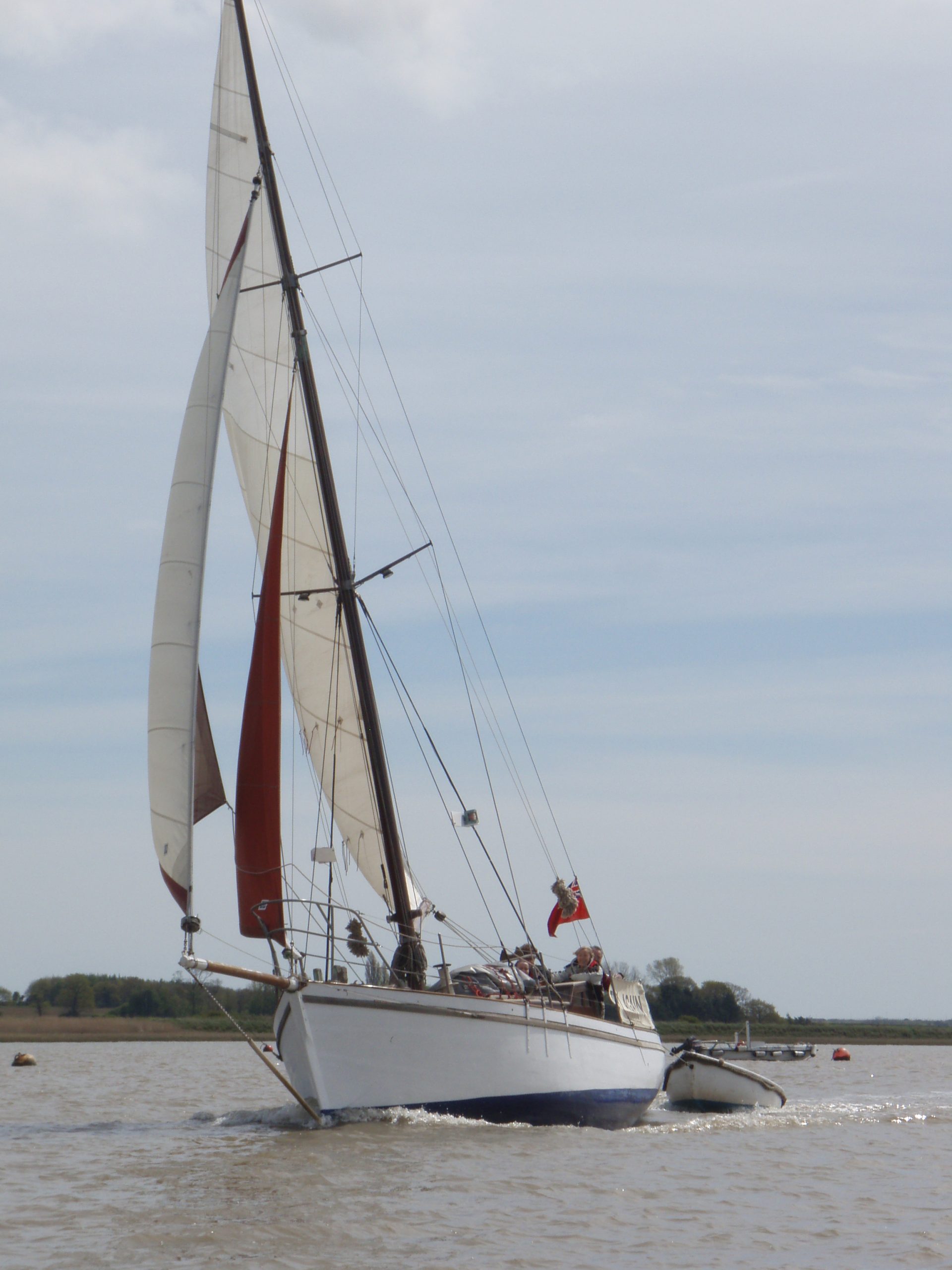
Try Again (1861).
I first noticed TRY AGAIN’s startling age – she’ll be 165 this year – when there was a Maritime Woodbridge festival about fifteen years ago and all the boats along the Ferry Quay waterfront had placards with information about their history. There were some lovely visiting yachts. TRY AGAIN was just one of them. Someone pointed out to me that she had benefitted from some extensive renovation during her lifetime and thus much of her fabric is c20th rather than c19th. In 1933 she missed stays in a gale, hit a rock off the coast of Jersey and sank. Her then owner was elderly and it could have been the end for her. A man named David Richardson, who had often crewed on TRY AGAIN went to have a look at her: Went and looked at TA. Nearly every seam opened and oakum spewing out 2-3 planks knocked out starboard bilge. Keel strained and adrift from garboards. Engine heap of rust.
She was patched up and continued sailing for a few more years then, after her owner’s death, David Richardson bought her. After the hiatus of WW2 he spent five years 1947-1952 working on her, estimating finally that she was 2/3 rebuilt. He also researched her history and kept records. These days there’s information about TRY AGAIN via the Jersey Museum and also the Old Gaffers Association. She came to the Deben in 1961.
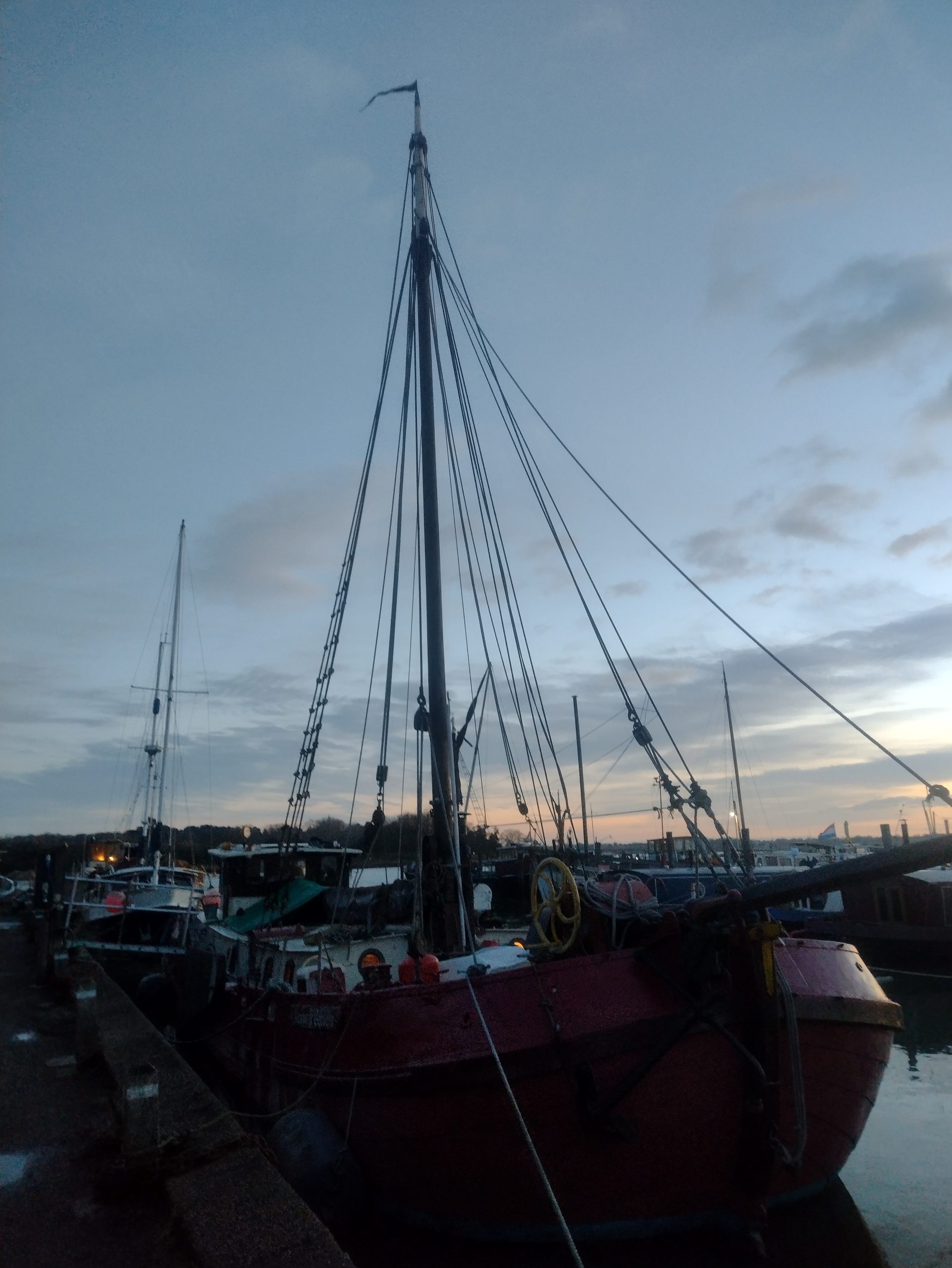
Aenna te Gondern (1890).
There’s no room now for a Maritime Heritage Exhibition along the Ferry Quay but one might look at it as almost a permanent floating display. One of my many memorable moments during this research was standing with Drew Whitmore, owner / custodian of the magnificent AENNA TE GONDERN (1890) looking across the dock as dusk was falling and cabin lights of houseboats were beginning to come on. Drew said something to the effect that there was no need to go travelling when all these boats had come to us. Yes, many of the houseboats currently moored in the Ferry Dock are modern purpose-built widebeams, inspired by canal boat designs but many are much older converted barges, some engine powered, some still with sails. Many are from the Netherlands. AENNA TE GONDERN was built in Gouda as a canal and sea-going cargo ship, powered by both sail and motor. Then she spent many years as a charter vessel in the Baltic and inland to Berlin. She’s still fit to go to sea.
The second oldest vessel on the river, WATERDOG (1876), a Humber ‘keel’, was built of iron in East Yorkshire and she too has only recently retired from the travelling life, She was originally fitted with a steam engine and, towing dumb barges, would trade between Hull, Goole, York and Rotherham, carrying many varied cargoes, including coal, manganese ore, linseed oil and bales of cotton. This project has made me more aware of our links with the Humber – leading inland via the Trent, the Don, the Aire and the Ouse to England industrial areas. At the top of Martlesham Creek I met Charlotte Ingham, joint owner of LIGHTCLIFFE who told me about the 100s of barges built to a standard ‘Sheffield’ size (around 61.5 ft x 15.5 ft) because those dimensions were the maximum allowed by the locks on the Sheffield and South Yorkshire Canal, enabling them to navigate inland from the Humber Estuary to Sheffield’s industrial heart, providing efficient bulk transport for goods like coal. A bit like modern ‘panamax’ dimensions, perhaps. Their robust design also allowed them to handle coastal waters and rivers. Today they provide the foundations for homes, though LIGHTCLIFFE’S sister, SOUTHCLIFFE can still be seen sailing with a traditional square rig.
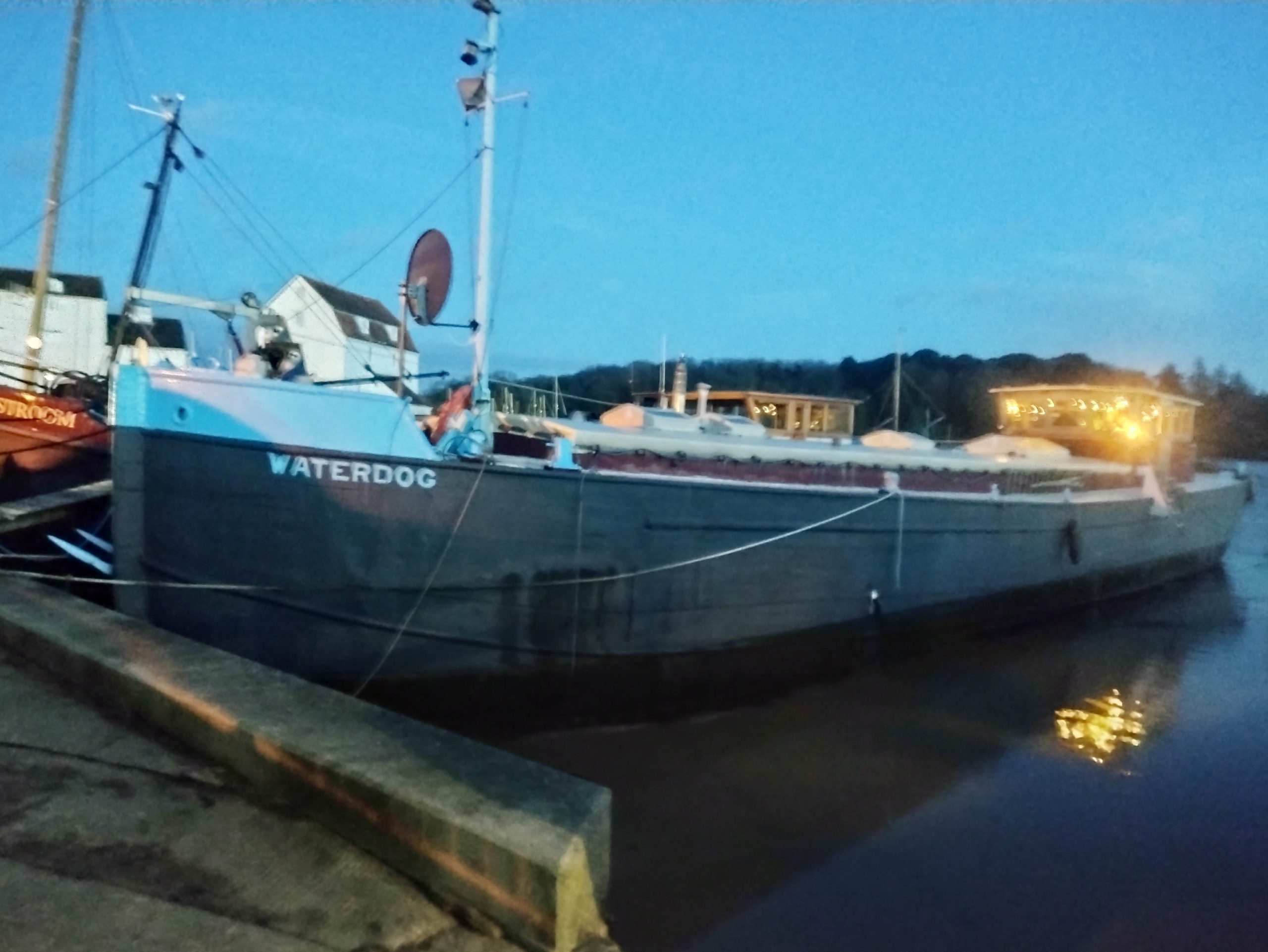
Waterdog (1876).
With so much emphasis on the sturdy – and often semi-static – former cargo boats (plus tugs and fishing vessels) it won’t do to forget the elderly, utterly elegant yachts – such as KESTREL (1891), CACHALOT (1898), CAPRICCIO (1912), a joy to watch, particularly in a fair breeze on a sunny day with topsails set. All three of them are South Coast ‘gentleman’s yachts’ which have migrated to the Deben. Two at least owe their continuing existence to the quite extraordinary dedication and rebuilding skills of their current custodians. MARGUERITE EXPLORER (1934) is an arrival from the North, built in Denmark as a fishing boat (she had a ‘wet well’ where fish could be kept alive – and thus fresh – when ice was not easily available) and then working in Scotland for many years as a charter vessel. She is currently undergoing a complete renovation, undertaken, essentially single-handed, by her owner Chris Dean. A peep down below gives just some idea of the magnitude of the task, and the strength and beauty of her original construction.
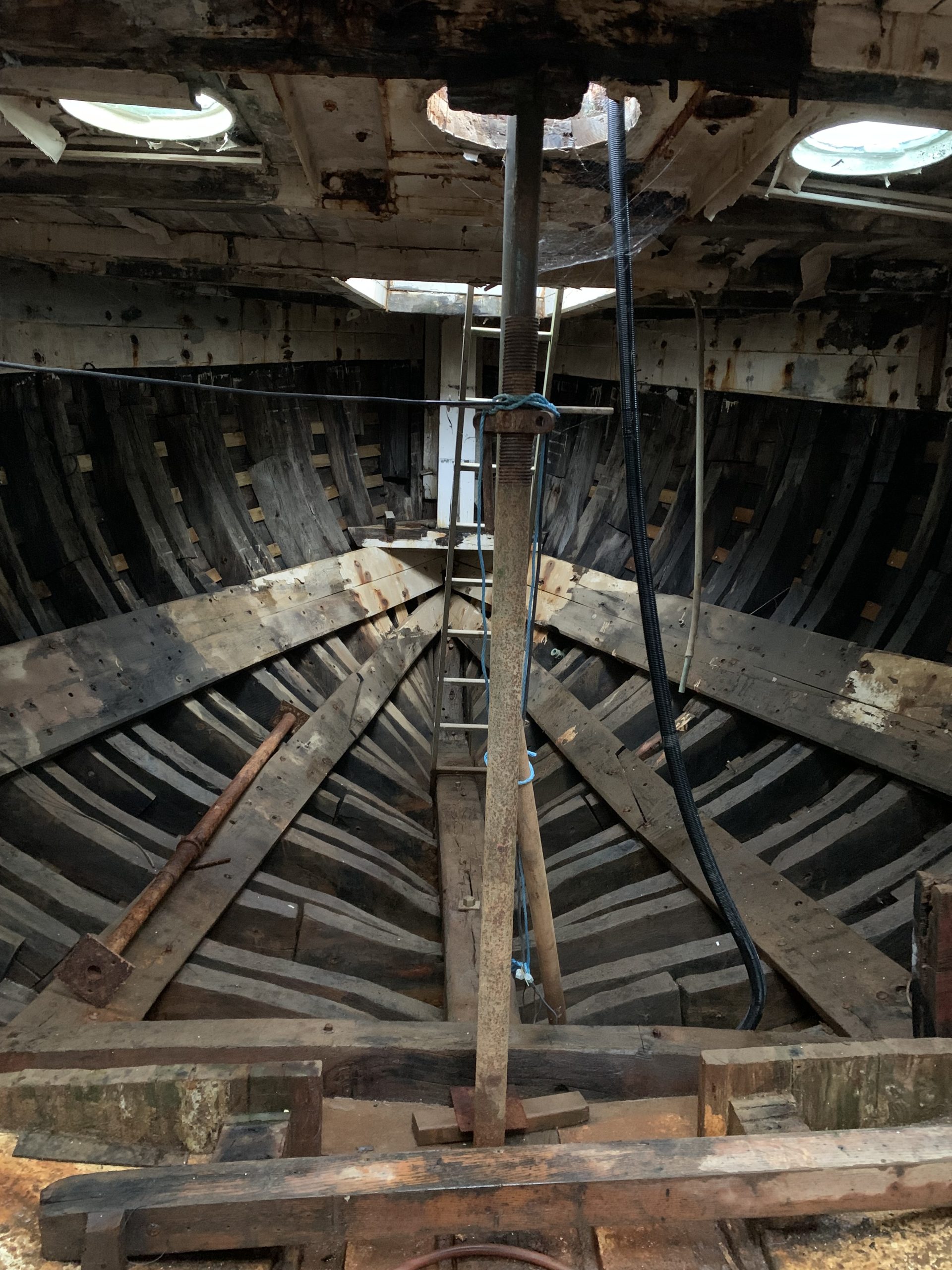
Marguerite Explorer (1934), below deck.
On the Deben we are fortunate that we still have craftsmen able to do the work (at least in wood) that is beyond the skills of many, well-meaning owners (I speak for myself here). It is vitally important that we continue not just to conserve but to grow those skills. There are many rivers now who do not have the boatyards able to take on such jobs. Classic wooden racing boats from the Crouch and the Alde, for instance, now come here for refurbishment and repair. One impulse behind this project was to contribute to the idea of the Deben being seen as a ‘Heritage Harbour’ even if we decide not to seek this official status.
Our home-built boats are special – there’s CLYTIE (1922), BLACK CAT (1938), the Cherubs (1920s-1930s) and the Waldringfield Dragonflies (1949). MAID OF VERYAN (1949) represents the large class of Deben 4 tonners but in the past there have been so many more Deben built boats. While I wish I had found a surviving example of the Kingfishers or the Felixstowe Ferry One Designs, yet CARIAD, BESS, HOBBY and SASHA are all 11’-14’ clinker dinghies built in the late 1940s and going strong. Better still their lines are available for new versions, and the skills are still here to produce them.
This list was restricted to boats that were still on the river during 2025, at least for some of the time. When time permits I will add a little list of those notable yachts that did not make it to the water last year – or who wait in the ‘Tent of Dreams’ for someone to fall in love with them.
I began 2025 posting articles to celebrate our Dunkirk little ships MAID MARION (1925) and CACHALOT (1898). My most recent walk along the river wall led me to two WW2 neighbours. ‘The Barge’ is a former WW2 ammunition barge, converted afterwards as bed and breakfast holiday accommodation and now being energetically renovated by the next generations of her family. Her neighbour HSL 2605, built in 1942 as an RAF high speed rescue launch (and included on the Historic Ships register) is in a miserable state and in urgent need of rescue herself. It’s inconceivable that she will still be here, if we were to repeat this survey in five year’s time. I wonder how many other souvenirs of our European history will have gone with her?
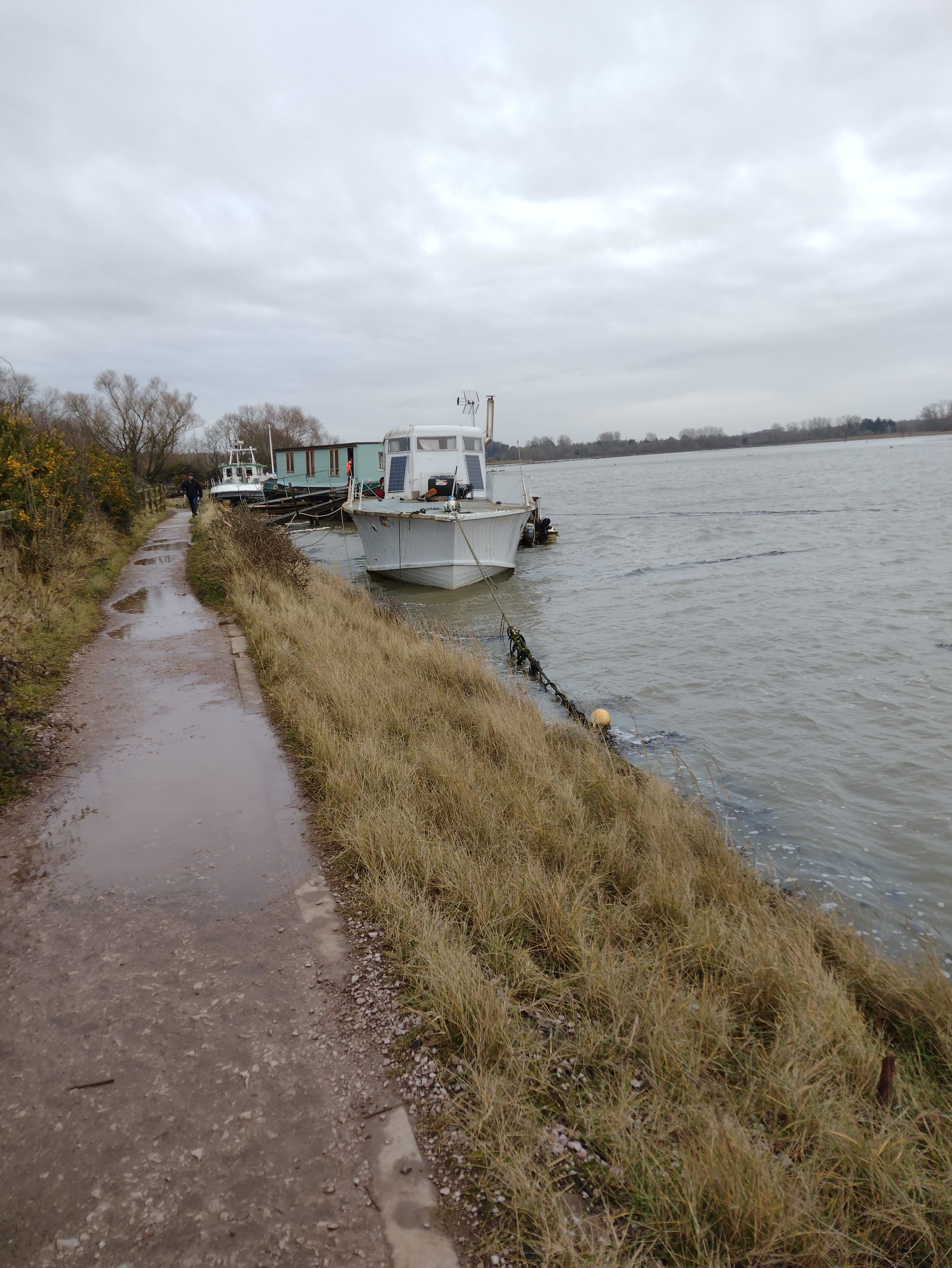
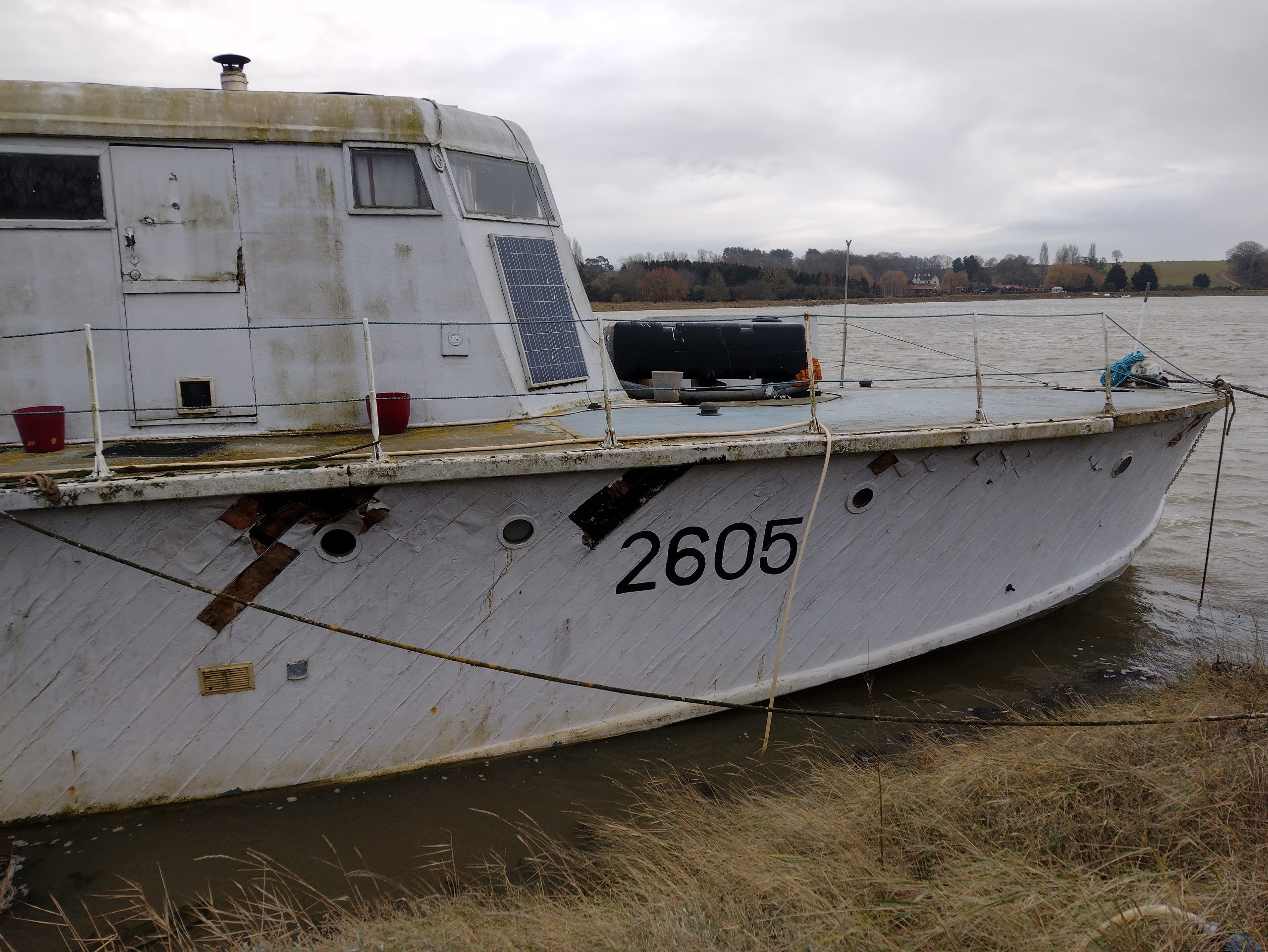
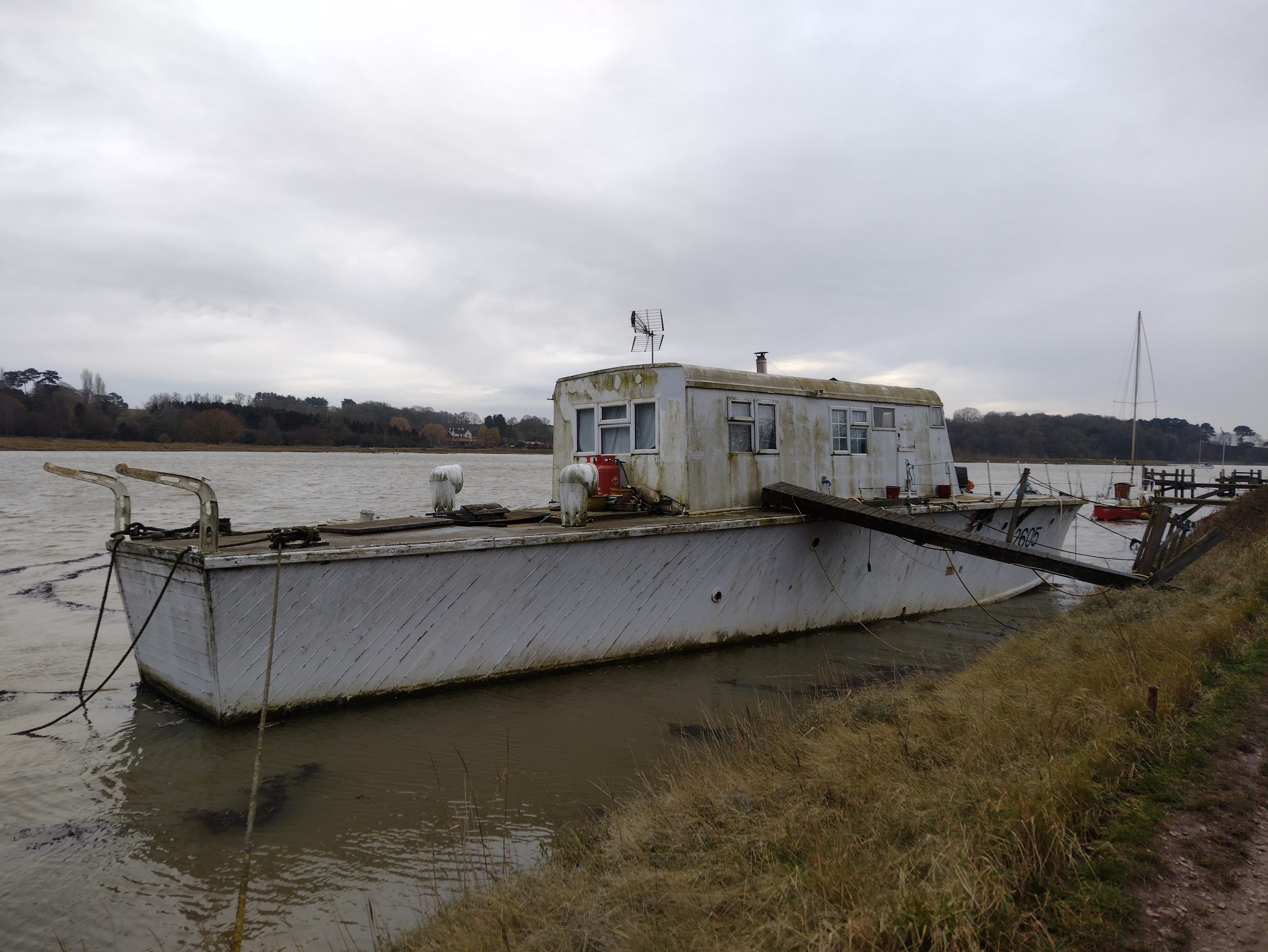
HSL 2605 (1942).