by Julia Jones
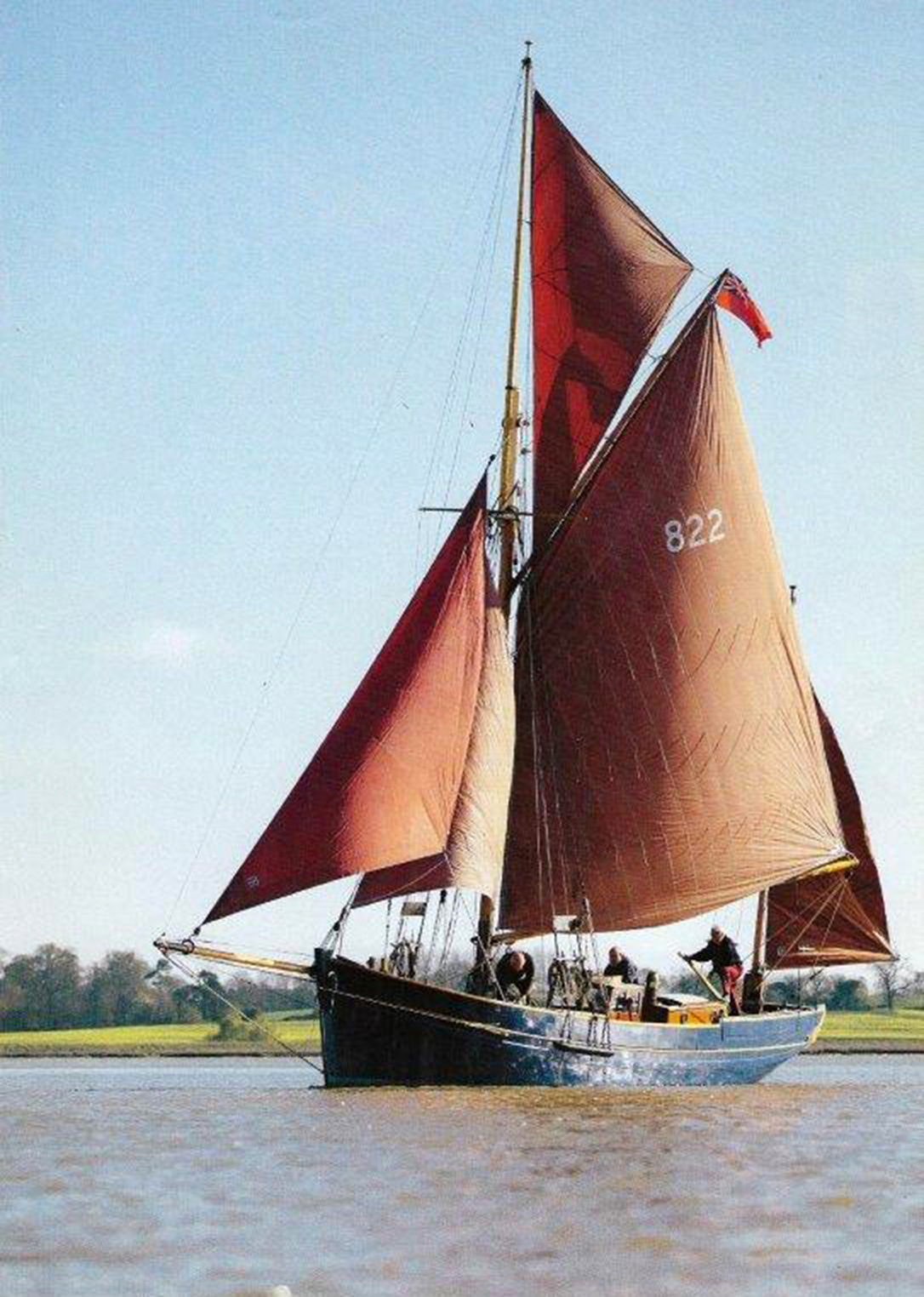
Dusmarie.
No-one, sailing through Ramsholt in the later part of the c20th will have failed to notice Dusmarie, moored just below the entrance to Kirton creek, unique, beautifully maintained and always with that indefinable air of capability and class. But what of the people connected with her? Astrid Llewellyn (née Dixon) who has recently died (22.1.2026) grew up on Dusmarie, sailed many thousands of adventurous miles on board, was the first woman to skipper an all-female team in the Sail Training Association Tall Ships race and supported her mother in making a distinctive contribution to girls’ outdoor education.
Astid and Dusmarie were inextricably linked from before she was born. Her parents Douglas and Mary Dixon jointly owned the yacht from the time of their marriage in 1933. Mary had paid for the purchase of the former Colne smack Daisy (built by Aldous of Brightlingsea in 1884), and Douglas had funded her conversion into a yacht, which would also be a family home. She was their mutual wedding present to each other. On Midsummer Day 1933 Douglas and Mary were married on board, moored off Greenwich on the meridian. Daisy became Dusmarie, an amalgamation of Douglas and Mary as they began their new life.
Superficially Astrid’s parents might have seemed an oddly assorted couple: he had been one of the Blake term of cadets at the Britannia Naval College, Dartmouth, who had been marched away to war, aged just 15, at the outbreak of the Great War. They had been sent to join ships of the reserve fleet, patrolling the Broad Fourteens in the North Sea. Half of his classmates had died when the cruisers HMSs Aboukir, Cressy and Hogue were torpedoed by a single German submarine on 22.9.1914. By the spring of 1915 Douglas, still only 15 years old, was awarded DSC while serving at Gallipoli as a Midshipman. He survived the war and accepted retirement from the Navy in his early 20s but those experiences had left their mark.
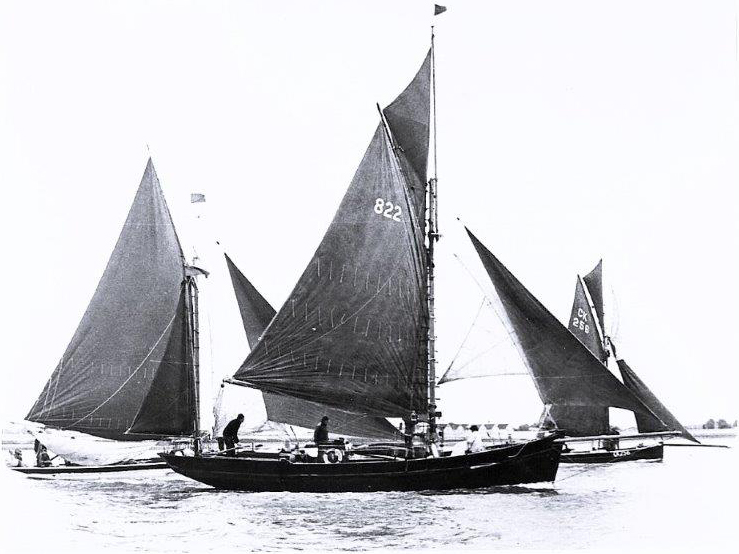
Dusmarie smack racing.
Astrid’s mother, Mary Turner, had been educated at home by governesses and private tutors, had studied Modern History at Lady Margaret Hall College, Oxford and had gained First Class Honours in her special subjects of Banking and Public Finance. Her college had sent her to study municipal finance in Germany and by the time she met Douglas she was a principal in the economic intelligence department at Barclay’s Bank. Astrid always insisted that her parents’ marriage was a true partnership. She also said that no-one, except her mother, would have put up with her father.
Mary had to resign her job on marriage. Douglas, though highly intelligent was not readily employable, but the couple survived by writing, lecturing, living and cruising on Dusmarie and occasionally renting some waterside cottage. Astrid, their only child was born in 1940, in London, where both her parents were involved differently in war work and Dusmarie had been left in a boatyard in Sweden. Bombed out of their London home, Astrid’s early years were spent in Pin Mill in a cottage belonging to her godfather James Wentworth-Day. Finally in 1946 they travelled to Sweden to discover Dusmarie, uncovered, neglected and apparently in the final stages of dilapidation. They rebuilt her.
Douglas and Mary also negotiated with the Swedish government for use of an island, Manno, where they could offer sailing and camping to British school children from 1947. In the winter they led expeditions to Lapland. When they were back in England, Astrid, aged 7 attended Deben Bank school in Woodbridge.
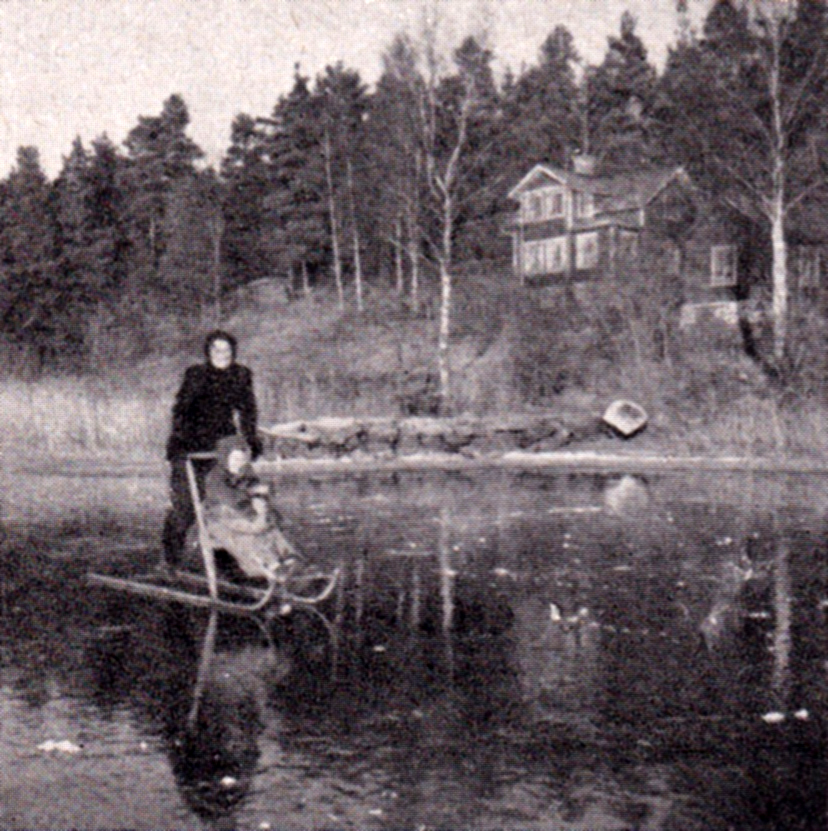
July 1948: Astrid and her mother in Sweden, where Dusmarie had been hauled-out during the war.
Original caption: ‘The mate and cabin girl “sparked” to the local shops while work was held up by snow or jollifications.’
The first Manno expeditions were for boys only but Mary, Astrid’s mother felt passionately that girls also needed adventurous, outdoor education. From 1950 annual expeditions were organised (separately) for both genders. They became more varied, often based in the Netherlands as well as Scandinavia. The enterprise lasted formally until 1953 though there were more, less formal expeditions in the later 1950s. Before that, when Astrid was 15, her parents decided firstly that she should begin to get racing experience to qualify as a cadet member of the RORC (Royal Ocean Racing Club), secondly that they would spend longer living aboard Dusmarie in the Mediterranean, while she commuted to and from boarding school to join them wherever they were and, finally, that they would sail to Gallipoli for Anzac Day April 25th 1957. After which Astrid, now 16, travelled back to the UK on her own via the Orient Express. By the time her parents and Dusmarie finally arrived home in the UK in the winter of 1963, Astrid was close to qualification as a nurse in St Thomas hospital, London.
Douglas and Mary settled back into their house at Playford near Ipswich where Douglas died, suddenly in 1964, possibly by his own hand. Mary opened a sixth form college ‘Bransons’ in their house at Playford and she and Astrid took over the daunting legacy of managing Dusmarie themselves. They were determined that she should continue to work as a training ship.
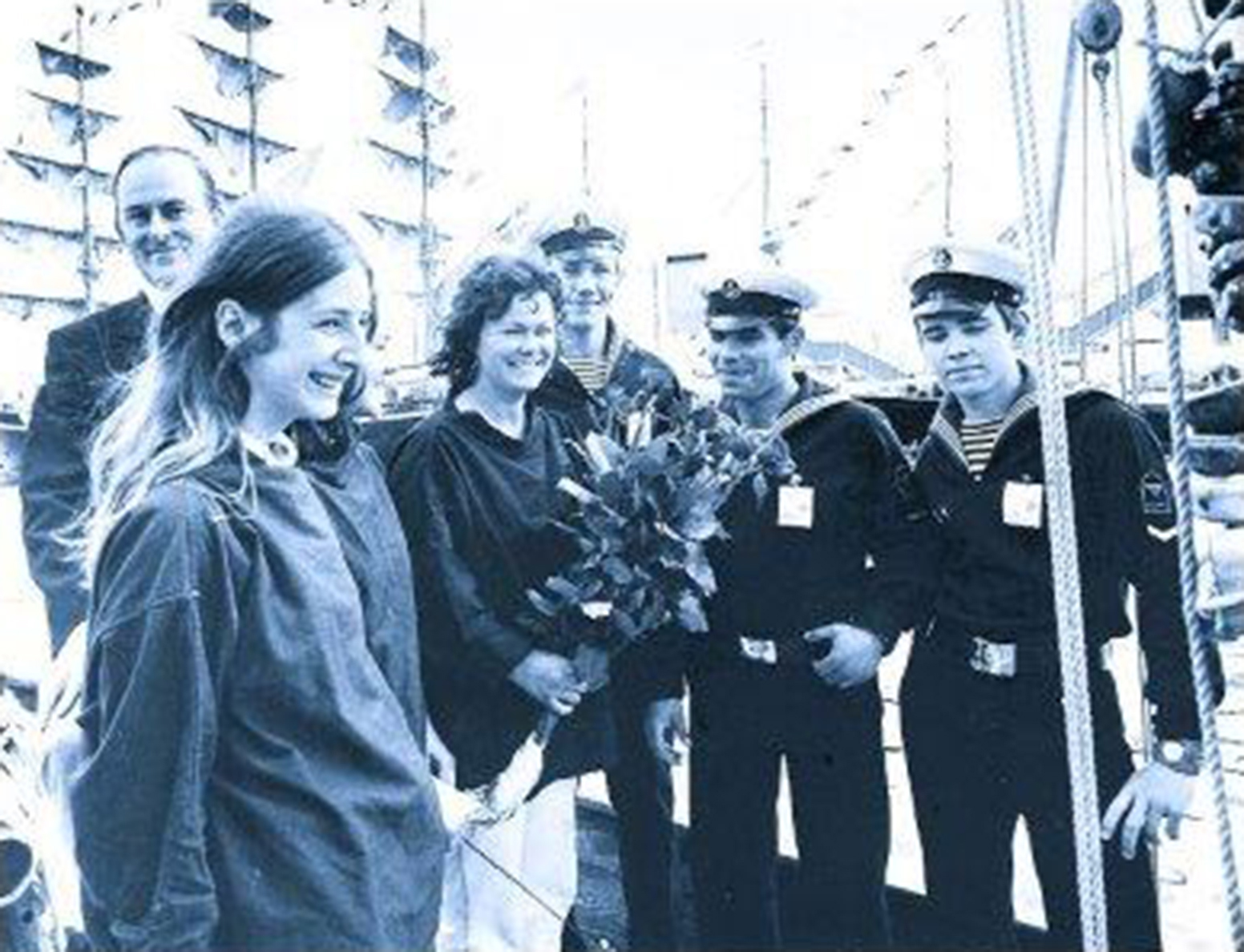
1974: Astrid at the Tall Ships Race, captaining the first all-female crew.
Astrid’s capacity to help her mother through the next few years was limited as she married Donald Westbury, a widower with two young sons and moved to Wethersfield in Essex where she had two children of her own, Douglas & Tabitha. In 1970, however, she and Donald divorced and she moved back to Playford with all the children, ‘pool’ nursing, helping her mother with Bransons, sailing and maintaining Dusmarie, taking her children on board for summers in the Baltic. In 1973 Dusmarie moved firmly to the Deben for a refit at Whistocks before participating in the Tall Ships race of 1974 with Astrid as captain and a crew of 17-year-old girls from her mother’s college. Astrid, who was profoundly dyslexic, never trusted herself as a navigator and was supported by a male friend. Nevertheless, out of the 54 entrants to that year’s race Dusmarie was the only one with a female skipper and female crew – and the first since the annual Sail Training Association events began in 1950. She offered regular sailing to Bransons’ students and joined 22 other sailing training ships at the 1977 Fleet Review at Spithead to celebrate the Queen’s Silver Jubilee. Astrid and Dusmarie competed in Tall Ships races a further 7 times before retiring in 1985 to become a family yacht. She was then 101 years old.
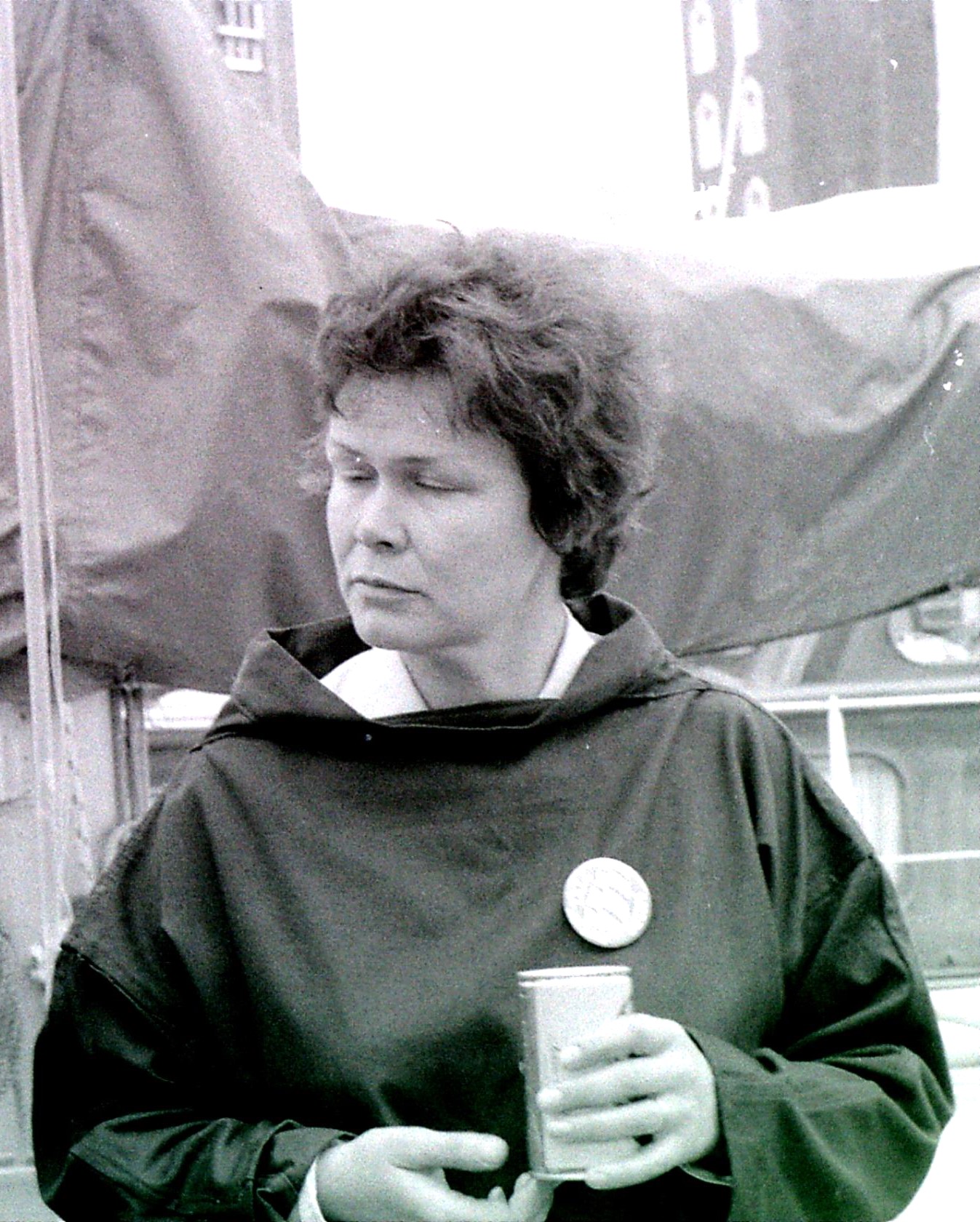
1978: Astrid taking part in the Tall Ships race from Yarmouth to Oslo.
In 1981 Astrid married Tim Llewellyn who she had met on the 1978 Tall Ships race from Yarmouth to Oslo. Together they helped with the running of Bransons College and after Mary’s death in 1983 Astrid continued to follow her mother’s ideals.
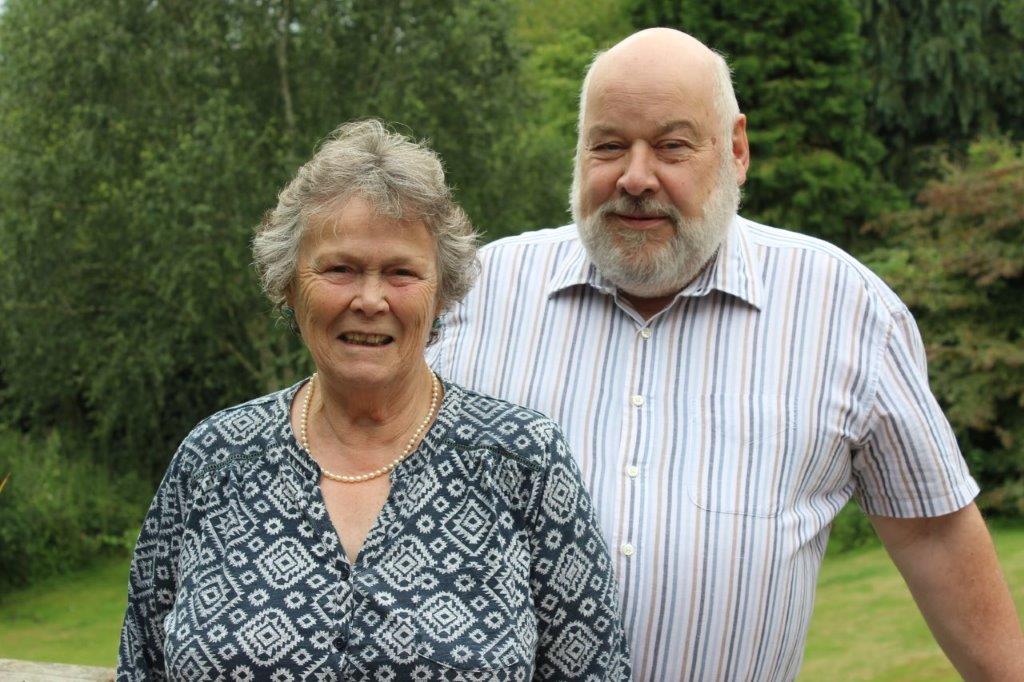
Astrid and Tim.
Despite her dyslexia, Astrid, always a battler, studied for an Open University degree which she completed in 1985. Educational provision was changing and in 1989 Astrid and Tim closed Bransons. Tim went on to become the Bursar at Amberfield School near Ipswich and the college buildings were let to Otley College as student accommodation. Without Bransons, however, the cost of maintaining Dusmarie in good condition for family use only became too much. In 1990 Astrid and Tim sold her.
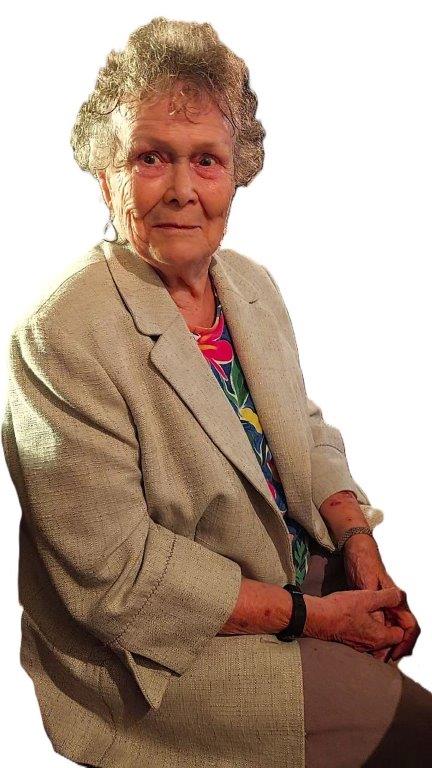
Life became less adventurous though not always easy. Astrid suffered from bi-polar disorder, as had her father, to a much greater degree. One of her children also needed support with mental health issues. Nevertheless, after the closure of Bransons College, Astrid was able to pursue her interest in gardening and undertook a part-time course in organic gardening at Otley College. She joined the Ipswich Organic Gardening Group and served as a committee member for a number of years.
Astrid was always concerned to help others and became an active volunteer for Age Concern and also Crossroads. She played an active part in village life in Playford and was a member of the church PCC as well as a member of the Women’s Institute. She became a yoga instructor and lead a weekly yoga group in the village hall. In 2019 Astrid and Tim reluctantly decided that the house and garden in Playford was too large to maintain and moved to a smaller property on the Chillesford Lodge Estate. She died peacefully and pain-free in Ipswich hospital on Jan 22 2026.
For some of us her spirit, and that of her beautiful yacht, will continue to linger somewhere at the top end of Ramsholt anchorage, just off the entrance to Kirton Creek.
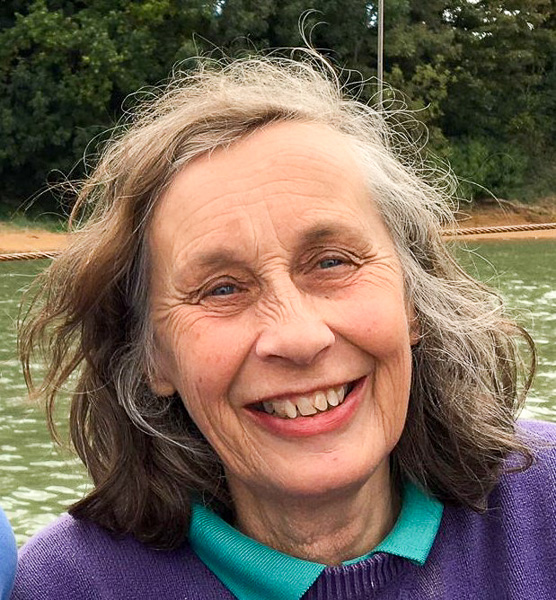
Julia Jones
Julia Jones is the editor of The Deben magazine, and the author of various books—including, most recently, Stars to Steer By: Celebrating the 20th Century Women who went to Sea, published by Adlard Coles.