Words by Julia Jones, Photos by Anna-Marie Sellon
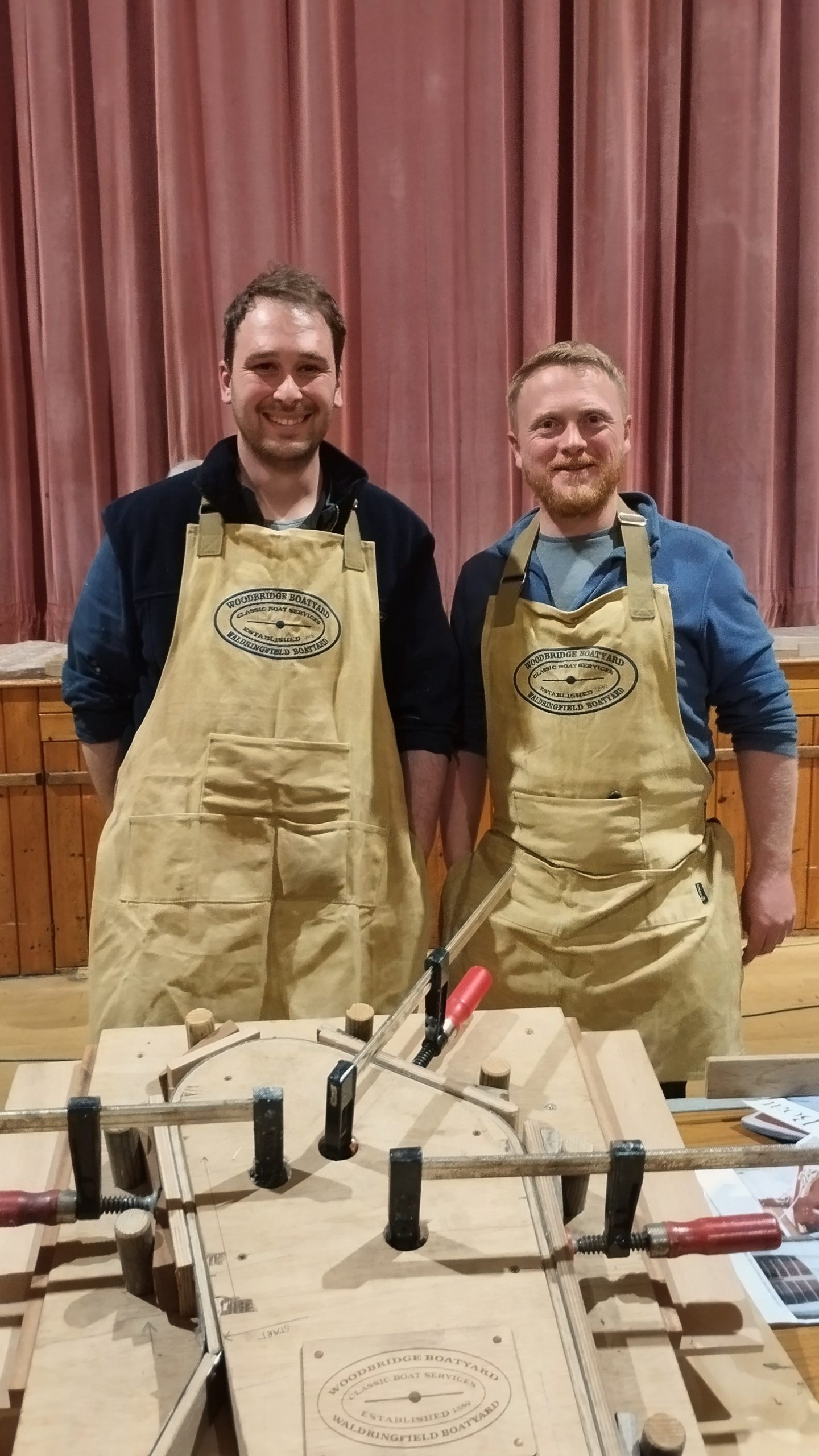
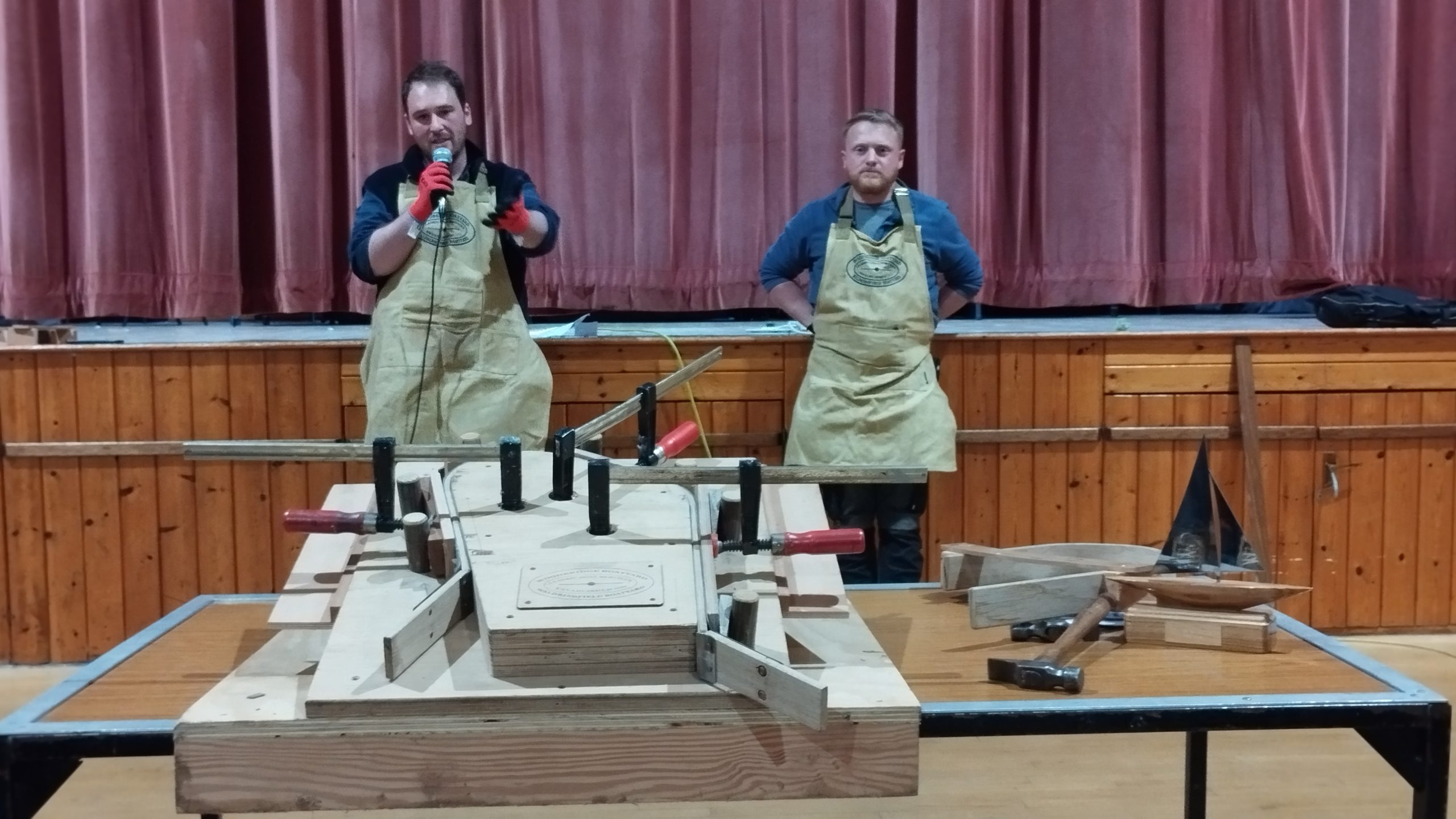
Dan Shemming and Matt Lis from Woodbridge Boatyard, giving a steambending demonstration at the AGM.
This was a particularly relevant and enjoyable AGM. Members had the opportunity to look at the exquisite sketchbooks of the ‘creative native’ Jackie Brinsley from Waldringfield before undertaking the essential association business. We also welcomed our new secretary Phil Skinner and new treasurer / membership secretary, Amanda de Margary. Out going secretary Caroline Peeke was thanked for her committed and effective work and also for being prepared to serve another four-year term on the RDA committee. Our co-chairman Colin Nicholson also entered his second four-year term. His is a demanding and varied role which he undertakes with great diplomacy and thoughtfulness, as well as a quiet determination to achieve results or (to quote his own remarks about the current crisis in the upper Deben area between Ufford and Melton) to persuade the statutory agencies to turn words into effective actions. He deserves our gratitude. (The Minutes of the meeting and business papers will all be available on the RDA website as usual.)
The main event of the meeting was a demonstration of Steam-Bending by Matt Lis, manager of Woodbridge & Waldringfield Boatyard, who is also a RDA committee member and Dan Shemming, a Woodbridge & Waldringfield Boatyard Apprentice.
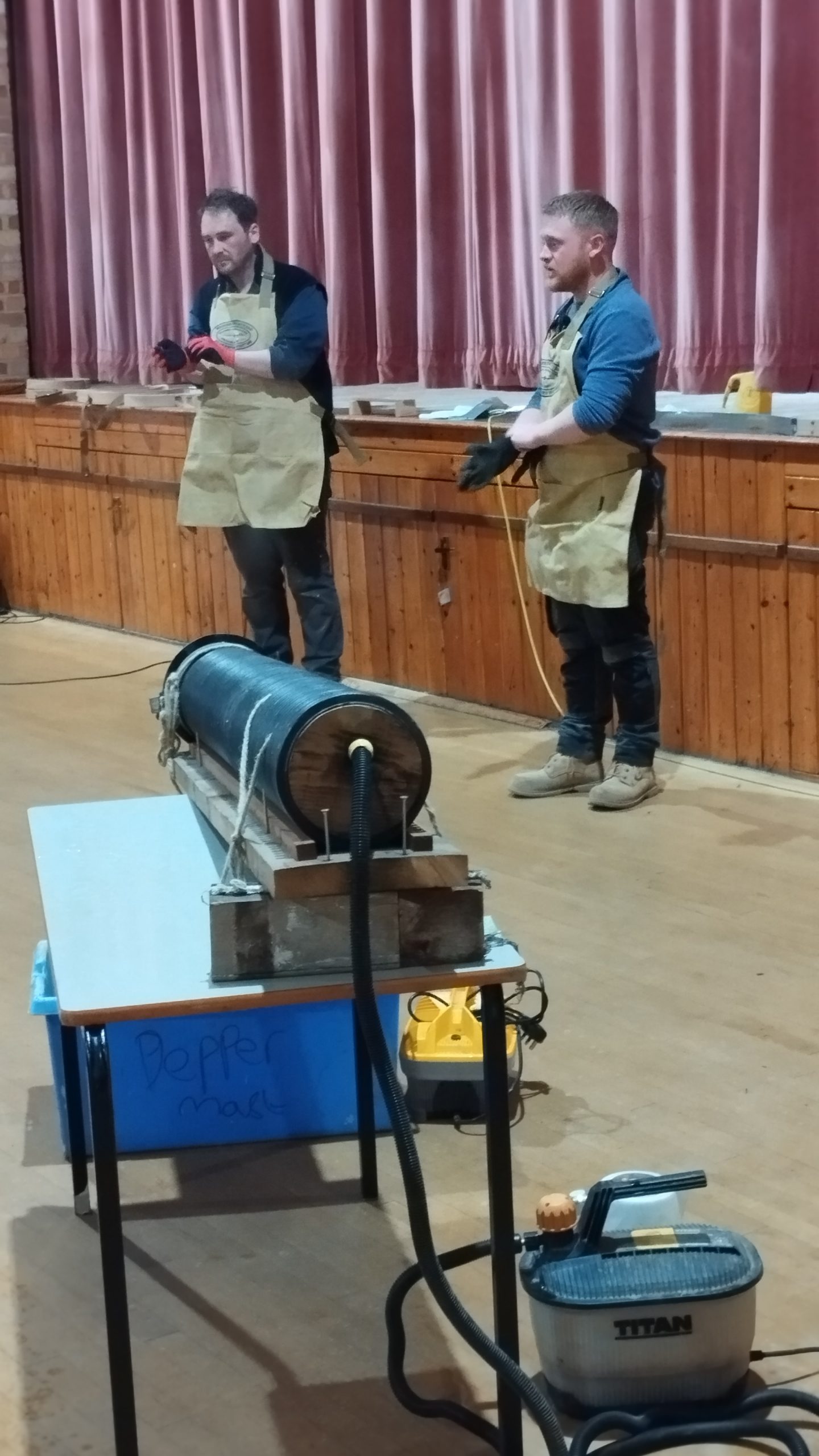
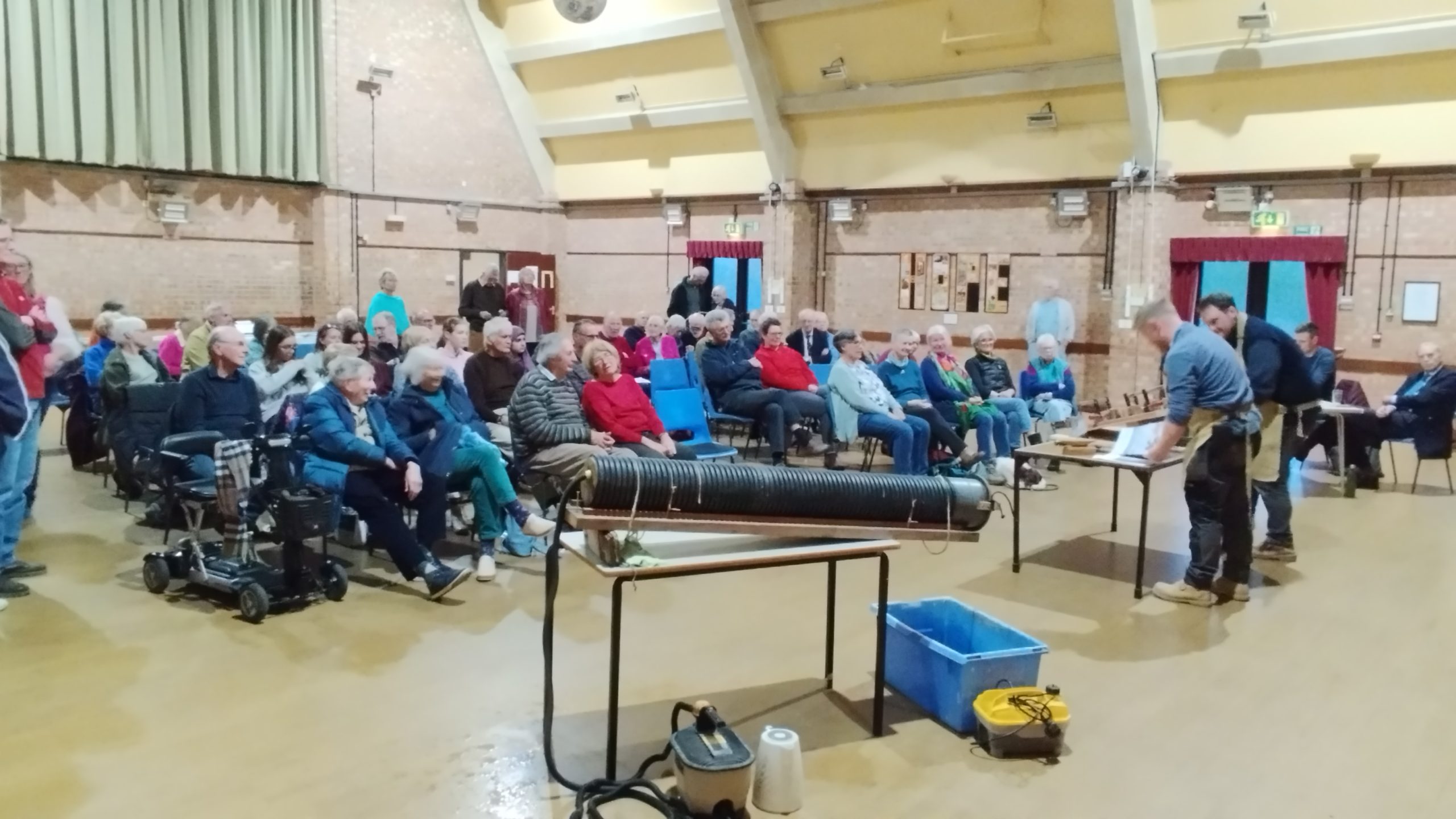
Matt began this fascinating demonstration by introducing himself and Dan, then explaining that the timer would dictate the shape of their presentation. The wood was already in the steamer and would need to come out at precisely the right time. Then the two of them would need to work quickly as the wood would begin to cool very fast once it was out of the steam box and needed to be bent to its new shape and fixed in position at once. The length of time required for steaming had been dictated by the thickness of the wood and (to a lesser extent) its type. A rough guide would be 1” of thickness to an hour of steaming. Nevertheless estimating was not an exact science and if the initial attempt did not work, there were no second chances. Often, if a whole set of boat ribs were to be steamed, for instance, so extra pieces would be put in the steamer in case of an occasional failure. Also, in the case of a particularly high value piece of wood, such as a rare piece of Burmese teak recently used to repair a Loch Fyne dinghy, several smaller, sacrificial, pieces might be taken out at five minute intervals to gain to gauge the time needed for the main piece more precisely.
Dan explained that the wood must be checked carefully to ensure that it was free of defects, such as knots. It would then be soaked overnight, either in the river or the tube they were using for the demonstration. This tube became the steamer and was angled slightly upward in an attempt to equalise the temperature within and also minimise the drips from condensation. The temperature within would be around the boiling point of water, ie 100°C. The heat source used for the demonstration was an electric wallpaper steamer and the wood used was locally grown Hemley oak.
Matt said that they use locally-grown native timber as far as possible and are developing their relationships with local landowners and farmers. Some of the oak grown at Hemley can brought up the river by boat, to reduce the yards’ carbon footprint and keep the business as sustainable as possible. They also use old stock that may have been stored for many years and will consider using good quality wood from broken up boats not suitable for restoration. However, when a large piece of mature oak was needed a few years ago (for Peter Duck), they had to source it from France, where forests are state-controlled, are more extensive and are managed more carefully than has been the case in Britain.
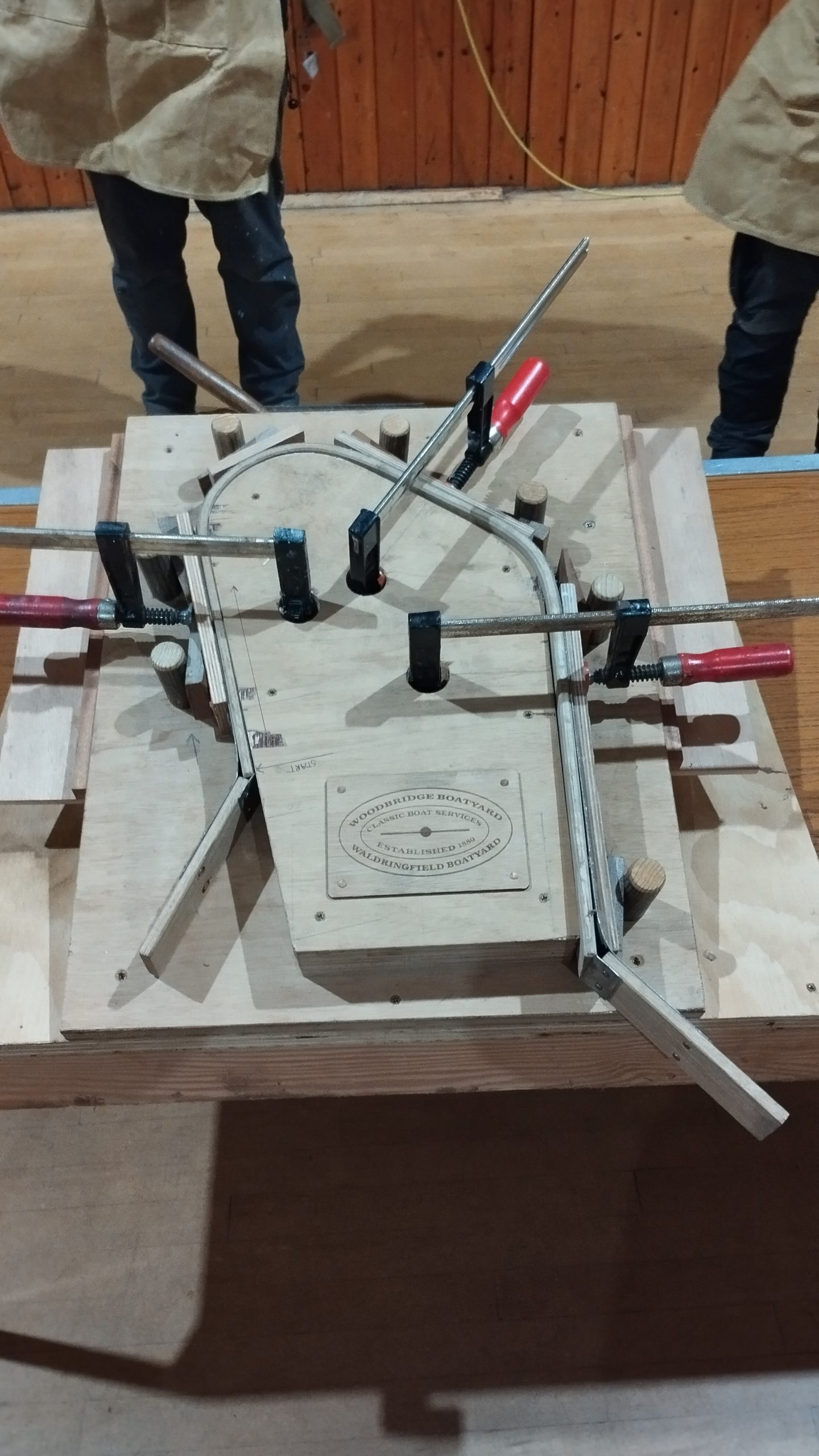
The aim of the AGM demonstration was to produce a wooden hook, bent round to form a hanger for a paddleboard or surfboard – an example of a centuries old technique being used for a contemporary purpose. When the timer announced that the wood was ready, Matt and Dan quickly removed it from the heat (wearing gloves and aprons) and bent it round a ready-prepared jig where it would be held in place as it cooled. They hammered pegs and wedges round the bent wood and also a steel band to hold it in place.
Normally the newly bent wood would be left to cool for 24 hours before being removed but the initial cooling is so fast that, for the purposes of demonstration, it could be taken out much sooner. Matt explained that setting up the jig — knowing where to place the pegs and wedges and how much spring-back to expect – is one of the essential arts of the shipwright. In theory any wood can be bent to any shape but in practice very tight bends do prove difficult. One technique used recently on the yacht Catspaw was to split the wood into two narrower bands and clamp and glue together afterwards. (This is called kerf-cutting.)
The chemical process taking place within the wood, is a rearrangement of the long cellulose fibres within the lignin which enables the new shape to be assumed with no loss of strength. When the lignin cools it sets like resin holding the fibres in their new shape. This is a one-shot process which cannot be redone if faulty.
A piece of straight, unsteamed wood was passed around for the audience to feel its rigidity. Then, after steaming the newly bent hooks were also passed round together with some previously steamed mast hoops. An alternative method of making curved shapes – such as the ribs of a wooden boat – can be by lamination, building up many layers of thin veneer, bound together with glue. This is sometimes used where light weight and exceptional strength are required but it is time-consuming and therefore expensive as a construction method. Steam bending, an ancient technique, is not only used in wooden boat-building but also in furniture-making, instrument making and even in the chassis of some classic cars. The Woodbridge Boatyard is about to begin a project with the Merchant Table shop on Market Hill, using steam-bending techniques to make furniture.
In the course of discussion and explanation, Matt also mentioned the technique of wood- splitting, currently in use on the local reconstruction of the Saxon Ship. There, saws are not used but wedges are driven into the wood with hammers and then the natural curves within the wood are followed to make grown knees and ribs, and also for planking. This ancient technique also offers great strength but leaves a lot of waste wood. This would not have been such a difficulty in earlier times when forests were more abundant.
A main theme of Matt and Dan’s presentation was the stimulus of combining traditional techniques with modern applications, or giving a contemporary, individualised twist to a classic design, perhaps using areas of lamination for aesthetic effect. One example being the recently built dinghy Oystercatcher, an Everson dinghy. This conforms to a one-hundred-year-old design but appears new and individual due the use of alternating bands of oak and mahogany which give a striped effect.
Photographs were passed around showing the variety of projects being worked on in the boatyard on any one day. Wooden boatbuilding, restoration and repair is a constant exercise in individual problem-solving and working to make the most of natural materials. Matt and Dan stressed that it is also an industry that offers 21st century careers. The system of Modern Apprenticeships can be accessed by school leavers but is also available to more mature people who are looking for a career change. Dan, for instance, had already developed expertise as a historic buildings surveyor before joining the boatyard. He specialises in the painting and finishing area but will be shortly achieving his overall qualification as a Boatyard and Marine Operative. He is one of a group of apprentices currently working at the Woodbridge & Waldringfield yards. The yards’ success in offering wider opportunities to industry entrants is one of the reasons it recently received a prestigious Classic Boat award (for which Matt also thanked the RDA and local community for their voting support). Another award recipient was Ariana Cottam, one of the group of ‘Rising Stars’ from the British Boatbuilding academy at Lyme Regis who were the first year group in the Academy’s history to achieve equal gender balance as well as outstanding work. The RDA was pleased to welcome a group of young women from Woodbridge School who distinguished themselves with their interested and intelligent questions.
This was a fascinating demonstration, putting traditional craftsmanship into a much wider human and environmental context. It reminded many of us in the audience, how fortunate we are to have such skill and commitment on our doorstep.